AI is transforming how e-commerce brands create product visuals. By using structured prompt packs alongside AI tools, companies like Brandwell have cut production time, reduced costs, and improved visual consistency across their catalogs. This case study highlights how AI workflows solve common challenges in product photography, from high expenses to inconsistent imagery, while enabling faster asset creation and better customer engagement. If you're looking to streamline your visual content process, this guide will show you how AI can fit into your strategy.
The Brand and the Problem: Inconsistent, Slow Product Visuals
The focus of this case study is Brandwell, a small direct-to-consumer company specializing in skincare and lifestyle accessories. They operate through their Shopify store while running ads on platforms like Meta and Instagram. Each month, they launched between 10 and 15 new SKUs. With professional product photography costing anywhere from $50 to $150 per image [2], a single product launch requiring five images per SKU could cost $2,500 to $3,500 monthly. For a bootstrapped business, this expense left little room for experimentation or scaling efforts.
The Visual Bottlenecks Holding the Brand Back
The high cost of professional photography wasn’t the only issue. The timeline for a typical shoot stretched 14–17 days, covering sample shipping, studio scheduling, shooting, retouching, and delivery [2]. By the time the final assets were ready, timely opportunities - like trending aesthetics or seasonal campaigns - were often missed.
Another hurdle was "visual drift", where inconsistencies in color tones, shadow angles, or lighting conditions crept into the product images over time. This lack of uniformity not only disrupted the appearance of product pages but also undermined customer trust. Research shows that even minor inconsistencies in visuals can create a perception of unprofessionalism, which can negatively impact conversion rates [2]. Ads featuring mismatched visuals underperformed, and with lifestyle shots costing upwards of $150 each, testing new creative approaches became financially unfeasible [2].
These combined challenges pushed Brandwell to seek a solution that could deliver consistent, high-quality visuals without the delays and costs of traditional methods.
Why AI Was the Right Fit
To address these issues, Brandwell needed a way to create consistent, brand-aligned visuals at scale - and do so quickly and affordably. AI-generated imagery emerged as the ideal solution, tackling the key pain points of cost, speed, and consistency. The idea wasn’t to eliminate professional photography entirely but to use AI for tasks like clean product shots, varied backgrounds, and lifestyle scenes. This approach allowed human oversight to focus on quality control while AI handled the repetitive, high-volume work.
With AI significantly reducing the cost per asset, Brandwell gained the ability to test creative ideas that were previously out of reach. The combination of cost-efficiency and speed made AI a practical choice for overcoming their challenges. What followed was a transformation in their workflow, powered by multi-category prompt packs and sharp visual direction.
sbb-itb-997826f
Choosing the Right Prompt Packs and Visual Direction
Brandwell's next move was to identify prompt packs that could deliver the visual impact they needed while addressing their consistency challenges. This meant carefully aligning specific types of packs to their unique use cases before generating any images.
Picking Product Photography-Style Prompt Packs
Fixing the inconsistent studio shots across Brandwell's Shopify store was the first priority. Product photography-style prompt packs were the perfect solution, offering clean, professional visuals: pure white or soft gradient backgrounds, realistic drop shadows, and subtle floor reflections. These packs created polished images that could be used directly on product detail pages (PDPs) without needing extra edits. Since image quality plays a huge role in purchase decisions, this was a critical step forward.
Once Brandwell had a reliable system for studio-style shots, the team expanded their focus to include lifestyle and campaign visuals for a broader brand appeal.
Adding Lifestyle and Campaign-Oriented Packs
While product shots handle the practical side of e-commerce, lifestyle visuals bring the emotional connection. Commercial and campaign-oriented packs helped Brandwell create aspirational scenes: a serum on a marble vanity bathed in soft morning light, a moisturizer placed beside a linen towel on a wooden shelf, or a face oil glowing in golden-hour sunlight near a window. These types of visuals enhance storytelling and resonate with customers.
A comparable skincare brand with 12 products used a similar AI-driven workflow to produce over 500 unique lifestyle images in just two weeks, cutting their monthly content costs from $3,000 to around $200 [1]. Brandwell aimed for a similar level of efficiency to keep up with weekly ad refreshes for platforms like Meta and Instagram, all while staying within budget.
Adjusting Prompts to Fit the Brand Identity
Choosing the right packs was just the beginning. Customizing the prompts to reflect Brandwell's aesthetic was equally important to ensure the images seamlessly aligned with their overall branding. The team translated their brand guidelines into specific prompt language, such as "soft natural morning light" for lighting, "minimalist warm-toned interior" for settings, and "clean and clinical with a hint of warmth" for mood.
Workflow: From First Test Images to a Full Visual System
Testing and Refining the First Prompts
To tackle earlier challenges with inconsistency, Brandwell began cautiously, testing the process on a small scale with three key products. This selective approach allowed them to iron out issues without risking mistakes across their entire catalog.
The team started with straightforward reference photos - basic iPhone shots taken against a white wall in natural light. These images ensured accurate details like product geometry, label alignment, and color representation. Using these references, they generated 10–20 variations per product, experimenting with different elements like background tones (warm white versus cool gray), lighting styles (soft diffused versus crisp directional), and compositions (centered versus slightly offset). A human reviewer carefully assessed each batch, flagging problems like distorted labels or unrealistic shadows. Adjustments to the prompts followed immediately, creating a feedback loop that smoothed out errors before moving forward.
This iterative process was fast and focused. They fine-tuned prompts by adding specific details such as "soft diffused lighting" or "warm neutral linen tone" to address issues like overly harsh shadows or cold, uninviting backgrounds. Within just a week, the team had narrowed down a reliable set of prompts that consistently delivered the desired results. Armed with these refined prompts, they shifted their focus to building a scalable system for broader use.
Building a Consistent Visual System Across Channels
The next step was to transition from a pilot project to a structured, scalable workflow that could handle the demands of multiple channels. The key was ensuring that all product images - whether simple studio shots or elaborate lifestyle scenes - looked like they came from the same cohesive shoot.
To achieve this, the team created an internal library of pre-approved prompt templates tailored to specific use cases. For example, studio shots followed one template featuring a white background, soft drop shadows, and centered compositions. Lifestyle scenes used another template, emphasizing warm, natural interiors with props and golden-hour lighting. For social media ads, they relied on a third template with tighter framing, higher contrast, and bold, eye-catching backgrounds. This system allowed them to quickly adapt to new products while maintaining a consistent visual identity across all platforms.
The result was a unified visual system where every image, no matter the format or channel, felt like part of the same collection. As Carlos Mendez, Marketing Director at Luxora Furniture, shared after implementing a similar AI-driven approach:
"The AI photos felt like they all belonged to the same collection. With our old shoots, you could tell some were photographed at different times. It made us look less professional, ironically." [4]
This newfound consistency - spanning product detail pages, advertisements, and social media posts - addressed a key gap in Brandwell's previous visual strategy, elevating their overall brand presence.
Results: Better Consistency, Faster Production, Stronger Performance
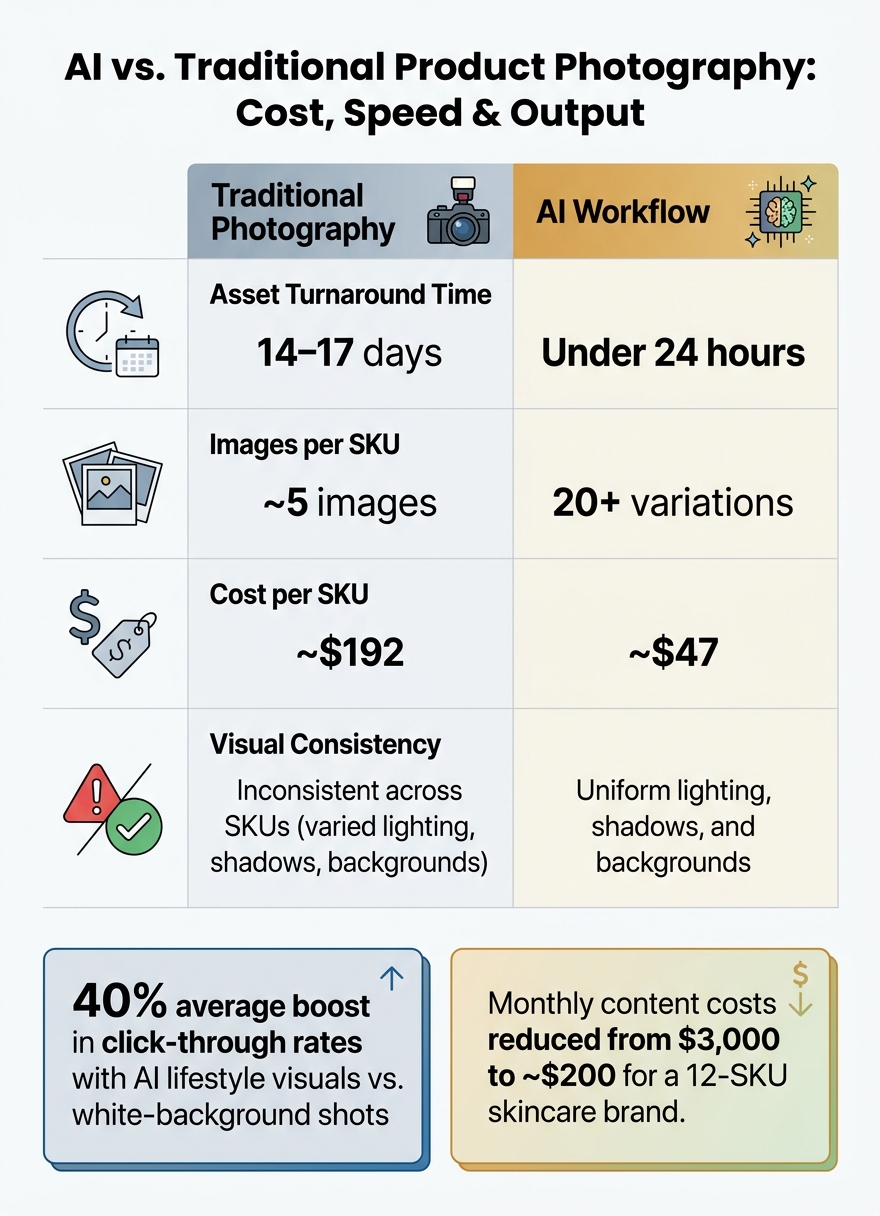
AI vs. Traditional Product Photography: Cost, Speed & Output
Visual Improvements: Before and After
Before integrating AI, Brandwell's product images lacked cohesion. Lighting varied drastically, backgrounds clashed, and shadows often appeared misplaced or inconsistent. The result? A catalog that felt pieced together from unrelated photo shoots, undermining the brand's professionalism.
After implementing the refined prompt system, the transformation was striking. Each image showcased soft, diffused lighting with a warm-neutral tone. Shadows were consistently placed beneath the products, and backgrounds - whether a crisp studio white or a cozy linen lifestyle setting - were carefully styled to maintain uniformity across SKUs. Lifestyle product shots, like ceramic candles on wooden surfaces or skincare bottles on marble, blended seamlessly with the overall aesthetic. This eliminated the "visual drift" that previously plagued the catalog.
The impact was most evident on product detail pages, where customers browsing multiple SKUs experienced a cohesive and polished visual presentation. This consistency not only elevated the brand's appearance but also built a sense of trust and professionalism, even without changes to pricing, copy, or site structure. The improved visuals supported broader efforts to optimize conversion rates, creating a foundation for measurable success.
Example Metrics: Time Saved and Performance Gains
Brands leveraging AI-generated lifestyle imagery have reported substantial improvements. For example, AI visuals have led to an average 40% boost in click-through rates (CTR) compared to traditional white-background shots. Aura & Co., a boutique cosmetics brand on Shopify, revamped its catalog with AI visuals in February 2026 and saw a 31% increase in core conversion rates. They also slashed their asset creation time from 17 days to just 30 seconds [2]. These examples highlight how effective implementation can deliver impressive results.
For Brandwell, early feedback showed immediate benefits. Internal requests to "redo" product photos before campaign launches disappeared, freeing up time and budget for ad spend and copy testing. This shift in workflow translated into clear efficiency and performance gains:
| Metric | Before AI Workflow | After AI Workflow |
|---|---|---|
| Asset turnaround time | 14–17 days | Under 24 hours |
| Images per SKU | Approximately 5 | 20+ variations |
| Visual consistency | Inconsistent across SKUs | Uniform lighting, shadows, backgrounds |
| Cost per SKU (example) | ~$192 [5] | ~$47 [5] |
Note: These metrics reflect outcomes from this specific scenario and similar case studies. Results may vary depending on brand, category, and execution.
Lessons Learned and Best Practices for E-Commerce AI Visuals
Brandwell's journey with AI visuals has revealed several important takeaways that can guide other businesses aiming to enhance their e-commerce imagery.
Where AI Visuals Work Best
AI visuals are particularly effective when dealing with high-volume needs and ensuring consistency. For example, creating over 20 variations per SKU, a process that used to take weeks, can now be accomplished in a single day. This scalability is invaluable for tasks like A/B testing ad creatives, updating seasonal imagery, and keeping product detail pages (PDPs) visually consistent across a large inventory.
AI also fills gaps that traditional photography struggles to address. Whether you need an "in-hand" shot to showcase product size, a flat-lay for social media, or a clean pedestal image for Google Shopping ads, AI workflows tailored for e-commerce can handle these scenarios without requiring a new photo shoot. A recent case study highlighted how using diverse AI workflows not only reduced photography expenses but also significantly boosted creative output [2].
Common Pitfalls and How to Avoid Them
One common mistake brands make is approaching AI image generation as a quick, one-size-fits-all solution. While tools like Midjourney and DALL-E are great for brainstorming, they often misrepresent crucial product details - such as distorting labels, changing packaging shapes, or altering brand colors. These inaccuracies can erode customer trust and lead to higher return rates [2]. To avoid this, it’s essential to use specialized e-commerce AI tools with controlled prompts and high-quality reference images.
Another key consideration is starting with a pristine "digital master" image. A clean, well-lit source image minimizes the risk of flawed AI outputs [2].
A subtler challenge is visual drift, which happens when team members work independently without shared guidelines or reference images. Over time, this can result in a catalog that lacks cohesion. To maintain a unified visual identity, brands should establish consistent parameters - like shadow direction, color temperature, and background style - and save them as reusable templates.
These lessons underline the importance of aligning AI-generated visuals with the brand’s overall strategy and identity.
How AI Visuals Fit Into a Broader Brand Strategy
AI visuals offer faster asset creation, cost savings, and a consistent look across a catalog. However, they are just one piece of the puzzle. Strategic elements like pricing, copywriting, site UX, and audience targeting remain critical drivers of conversions.
"In the hyper-competitive world of 2026 e-commerce, your visuals function as a key, yet complementary, component of your overall brand strategy." - Photta Content Team [2]
While high-quality visuals help build immediate trust, they deliver the best results when paired with other optimizations, such as engaging copy, effective audience segmentation, and a user-friendly site experience. Successful brands integrate AI-generated images into broader initiatives, like testing copy effectiveness or refining UX, rather than relying on visuals alone.
One practical approach is to begin with a pilot project. Test AI visuals on a small group of SKUs, then compare the click-through and conversion rates to your existing images. Use the insights from this test to guide a larger rollout. This step-by-step method lowers risk and provides actionable data before committing to a full catalog overhaul [3].
Building on these insights, here's where you can access the prompt packs that turned ideas into action. Art Prompt HQ's collections are crafted to help translate these strategies into practical workflows.
Where to Find Product-Focused Prompt Packs on Art Prompt HQ
Product Photography-Style Prompt Packs
If you're aiming to streamline your workflow, starting with packs tailored for e-commerce imagery is a smart move. Art Prompt HQ's product photography-style prompt packs offer options like studio setups, in-context scenarios, in-hand shots, flat lays, and pedestal visuals. These packs make it easy to create a cohesive visual system for any product line without having to juggle multiple tools or start from scratch.
Commercial and Campaign-Oriented Packs
Once you've nailed your core product shots, commercial and campaign-oriented packs help you branch into lifestyle settings. These packs include scene presets such as morning routines or golden hour backdrops that add depth and engagement to your visuals. For instance, a DTC skincare brand with 12 SKUs used these scene presets to produce over 500 unique photos in just two weeks, slashing their monthly content costs from $3,000 to about $200 [1]. This high output also enabled them to test 20–30 ad variations per campaign instead of the usual five, speeding up the discovery of top-performing creatives. Once you have a consistent visual library, the next step is learning how to turn those assets into revenue.
Resources for Monetizing AI Visuals
Even the most polished visuals need a plan to generate revenue. Art Prompt HQ's AI art prompts monetization guide offers actionable advice on strategies like A/B testing ad creatives and licensing images. For brands looking to present AI-generated work professionally, portfolio-friendly prompt packs provide templates to showcase visuals effectively and build trust with stakeholders.
"AI isn't here to replace good photographers. It's here to amplify visual capability at scale." - Focalworks [3]
This perspective applies whether you're a solo entrepreneur launching a product line or part of a marketing team managing hundreds of SKUs. The right prompt packs don't just make production faster - they create a system you can refine, scale, and even delegate over time.
FAQs
What AI tool should I use for product visuals?
For top-notch e-commerce product visuals, tools such as ProductAI and GemPix 2 are excellent for producing polished, consistent images quickly and at a reasonable cost. Broader platforms like Midjourney, Stable Diffusion, and DALL·E can also deliver great results, especially when used with well-crafted prompt packs. Your choice will hinge on what matters most to you - whether it’s automation, stylistic flexibility, or hands-on creative control. Prompt packs, in particular, can simplify the process for creating visuals tailored to product pages, advertisements, or social media campaigns.
How do I keep AI product images on-brand?
To keep AI-generated product images consistent with your brand, focus on aligning visuals with your established style, color palette, and overall aesthetic. Leverage custom templates or use specialized prompt packs that are designed to reflect your brand’s unique identity. Incorporate specific details like colors, props, and angles into your prompts, then fine-tune the results to ensure uniformity. This method not only reinforces a cohesive and recognizable look but also builds brand trust while making content creation more efficient and visually aligned with your identity.
Can I safely use AI images on Shopify and in ads?
Yes, you can use AI-generated images on Shopify and in advertisements, provided they accurately showcase your products and adhere to platform policies. These images are gaining traction as reliable options for product visuals and marketing, offering practical benefits for e-commerce businesses.