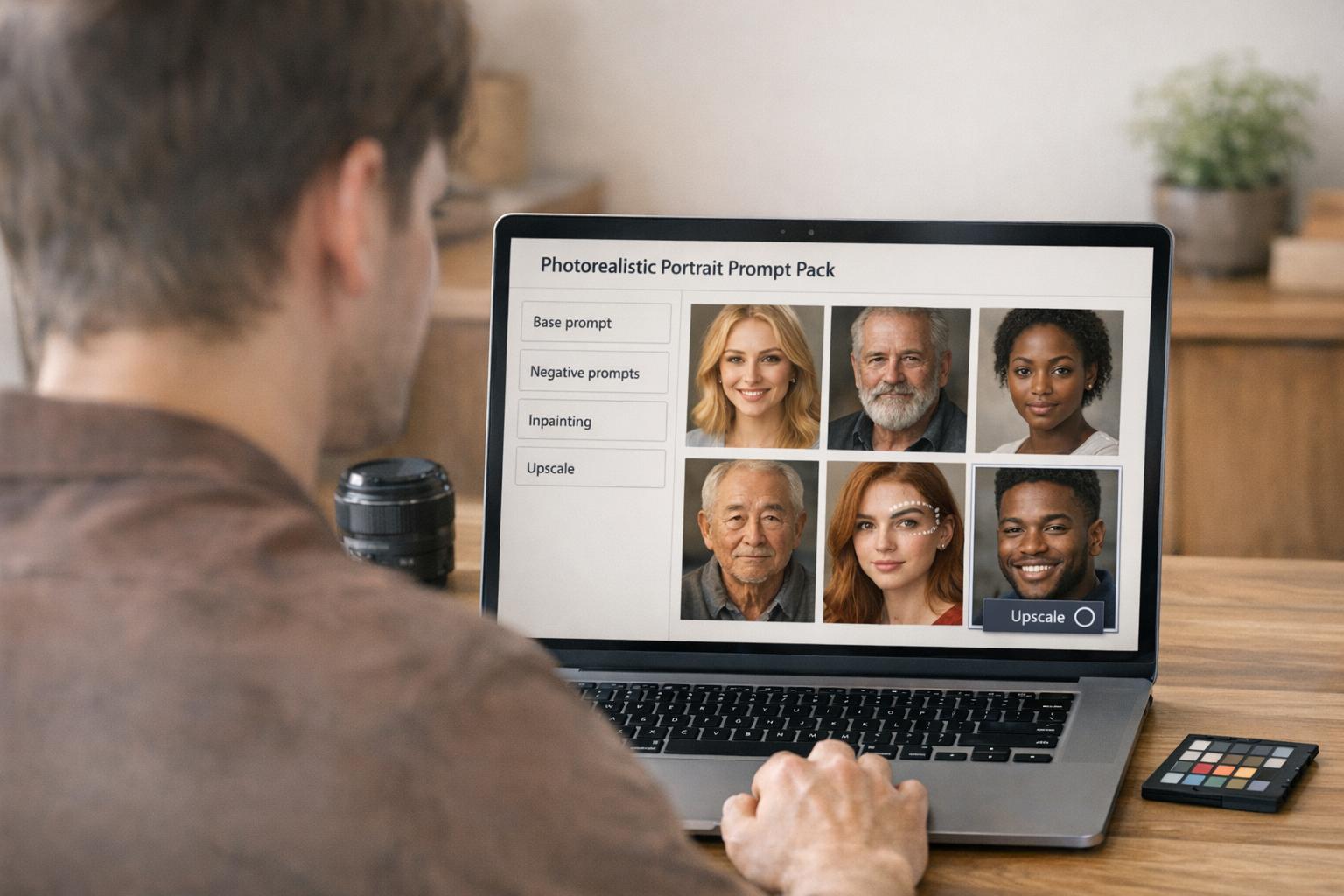
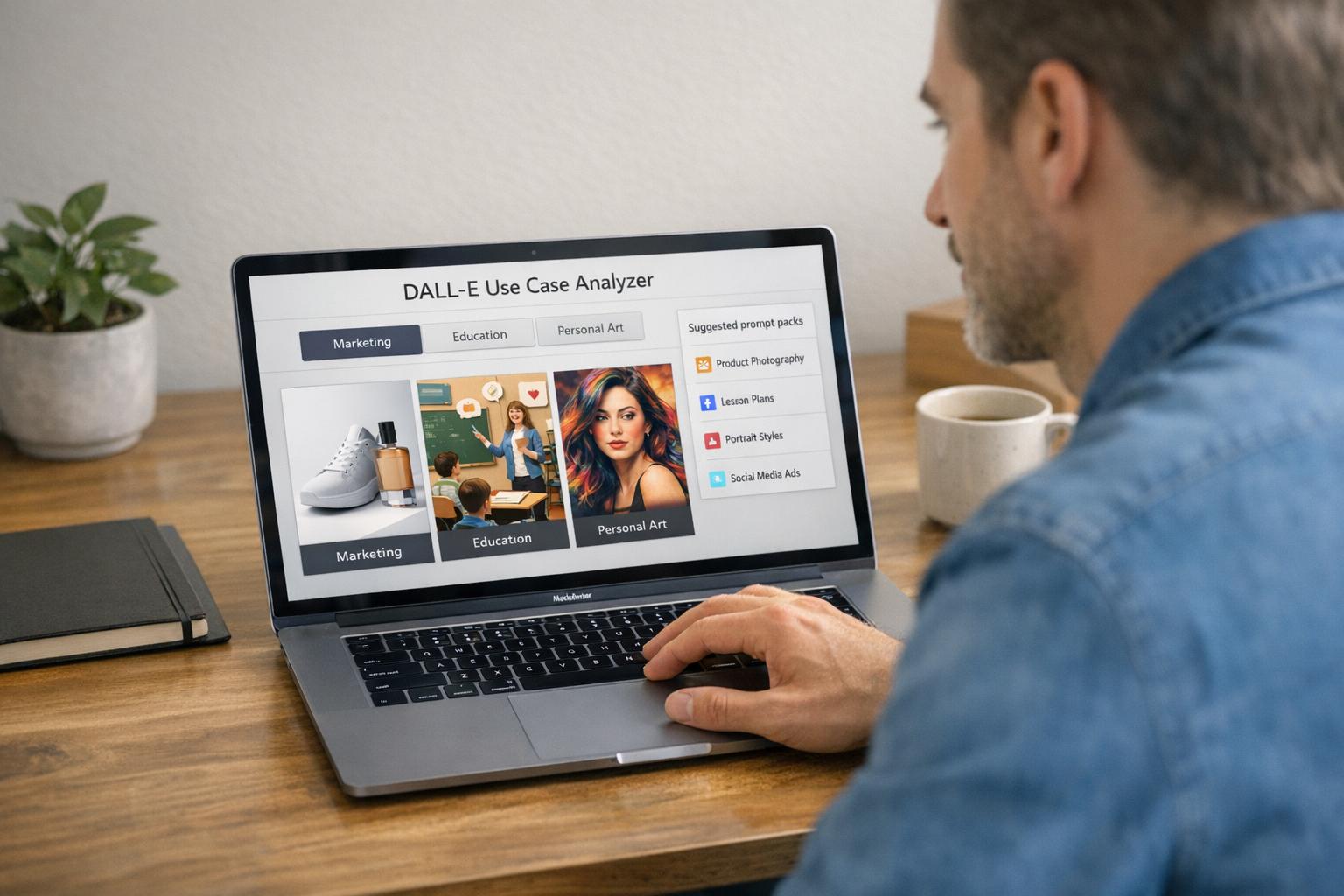
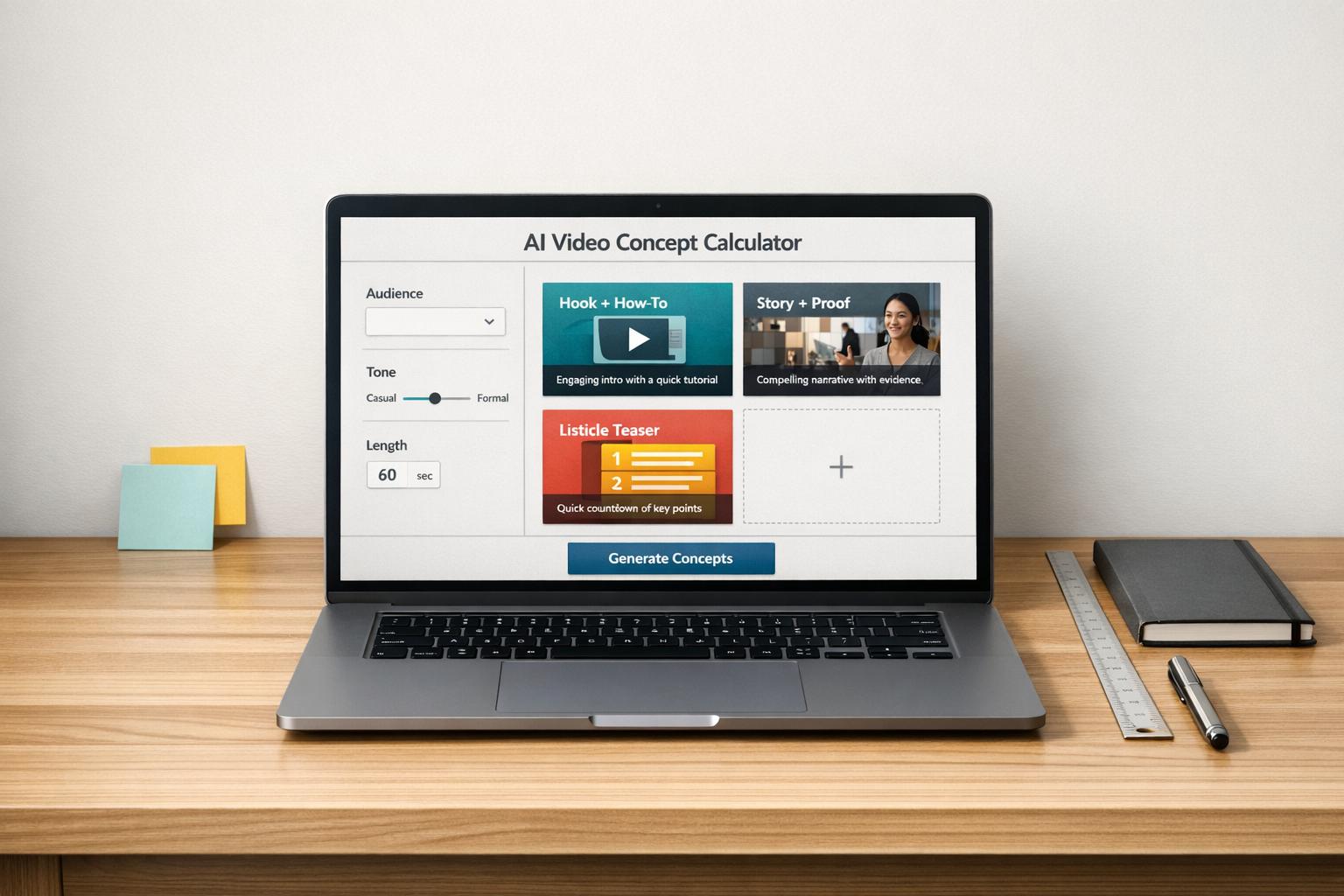
If you're tired of wasting hours on trial-and-error with AI prompts, prompt packs offer a way to save time and improve your results. Using an AI prompting master system with pre-tested collections are tailored for models like Midjourney, Stable Diffusion, and DALL·E, helping you skip the guesswork and focus on producing outputs that are closer to being client-ready. Whether you're a freelancer, an Etsy seller, or part of a creative team, prompt packs streamline workflows, reduce revisions, and ensure consistency across projects.
This article breaks down how prompt packs save time, improve quality, and deliver measurable ROI for professionals who rely on AI tools.
Why Prompt Packs Are an Investment, Not Just a Cost
At first glance, buying a Midjourney prompt pack might feel unnecessary, especially since many AI tools come free. But the real question is whether the time spent crafting prompts from scratch is worth more than the cost of pre-made solutions. Beyond the hidden costs of DIY prompting, these packs offer a clear advantage in terms of time saved and improved output quality.
The Problem with Building Prompts from Scratch
Creating prompts on your own can quickly become a time sink. Imagine a typical week: 1 hour researching, 2 hours writing prompts, and another 2 hours cleaning up inconsistent results - easily adding up to 5 hours per week. If you’re a professional charging $100/hour, that’s $500 of potential earnings lost weekly [2].
The inefficiency doesn’t stop there. Without structured prompts, every new project becomes a guessing game, trying to figure out which keywords will deliver the right look. This trial-and-error approach not only eats into your time but also drains mental energy, leaving you stuck in a reactive cycle instead of focusing on growth.
"Every minute spent tweaking a generic prompt to sound less generic is wasted time that could drive business growth." - Expert AI Prompts [2]
The Main ROI Levers of Prompt Packs
Prompt packs take much of the guesswork out of the equation. Instead of starting from zero, you tweak pre-designed templates, cutting a 20-minute prompting session down to just 2 minutes [4].
Here’s how they deliver value:
- Faster ideation: Ready-to-use templates jumpstart your process, bypassing the dreaded blank screen.
- Better first drafts: With parameters like lighting, composition, and angles already embedded, outputs are closer to being client-ready.
- Consistency across projects: Structured prompts help maintain a cohesive look, avoiding the visual inconsistencies common with improvised approaches.
- Reusability: A single pack can save up to 5 hours weekly, translating to $425 in reclaimed earnings for someone charging $100/hour [2].
To put this into perspective, let’s look at the numbers. If a professional aims to earn $150,000 annually (around $75/hour), a $47 prompt pack pays for itself in less than 1 hour of saved time [3]. The upfront cost of the pack is minor compared to the hours you’d spend reinventing the wheel. These time and quality benefits also pave the way for even bigger efficiencies, as we’ll explore in the next sections on workflow optimization and output quality.
Next, let’s dive into how these savings translate into measurable gains across creative workflows.
sbb-itb-997826f
Time Savings: How Prompt Packs Cut Down on Trial-and-Error
Trial-and-error can be a major drain on your time and resources. Each unstructured iteration eats into your schedule, and over the course of a week, those wasted minutes can quickly add up - especially for creators managing multiple projects.
How Much Time Creators Actually Save
A do-it-yourself approach to prompt creation can often take up to 5 hours per week. By contrast, using well-crafted prompt packs can shrink that workload to just 30 minutes [2]. This dramatic reduction in iteration time means you can shift your focus to tasks that directly contribute to your bottom line.
"Instead of spending 20 minutes crafting a prompt that produces mediocre output, you spend 2 minutes filling in variables and get an 80% finished result." - Rey Midas [4]
Structured prompts also reduce decision-making time by 40–60% [5]. For creators juggling responsibilities like social media content, client projects, and product designs, this efficiency gain is invaluable. It not only simplifies the creative process but also speeds up the time it takes to deliver polished results, making it easier to meet tight deadlines.
How Prompt Packs Speed Up Project Launches
The time saved through prompt packs doesn’t just streamline individual tasks - it can cut days from your project timelines. Without the need for endless iterations to achieve usable results, production schedules become more flexible. For instance, a campaign that might traditionally take three days to prepare can often be ready to launch in just one afternoon.
This benefit is particularly crucial for creators working under tight deadlines, like social media managers who need a cohesive set of visuals ready by Monday morning. High-quality prompt packs act as efficient pipelines: swap in your subject, and within minutes, you have a consistent and professional batch of assets. Teams benefit even more, as shared libraries eliminate the confusion that comes when each member experiments independently, producing inconsistent results [5].
The biggest time savings come from packs tailored to specific workflows rather than generic templates. These packs are designed to guide you from concept to final asset without unnecessary detours, making them a powerful tool for creators who value speed and precision.
Quality and Consistency: Better Outputs Across Projects
Prompt packs offer more than just speed - they bring a noticeable boost in quality and ensure reliable results across various projects, clients, or campaigns. These improvements save time in post-production and help deliver polished first drafts, directly increasing ROI.
Keeping Branding Consistent Across Campaigns
Maintaining consistent branding is a key driver of ROI. Without a clear structure, achieving a unified aesthetic can feel like chance. A comprehensive prompt library serves as a blueprint for a specific visual style, whether you're aiming for sleek product visuals, editorial photography, or stylized illustrations [1].
This is especially critical for teams. When individual team members experiment without coordination, the result is often a mix of inconsistent assets that require manual fixes before they can be used [10]. Prompt packs solve this by providing a shared creative framework - common lighting cues, composition rules, and tone instructions - ensuring every asset, from the first to the tenth, maintains the same professional quality [7].
"Verbal identity is where most brands lose coherence." - Faisal Saeed, Chatlyai.app [8]
The concept applies to text-based prompt systems as well. High-quality text prompts don't just mimic a brand's voice - they adjust it for specific platforms. For example, they can shift from a confident tone for LinkedIn to a more concise and direct approach for X (formerly Twitter), all while preserving the brand's core identity [8].
Getting Better First Drafts
Random prompts often produce outputs that are technically fine but lack originality. Since foundational AI models are trained on vast and varied datasets, their default results tend to be generic unless guided by precise instructions for lighting, composition, and mood [1].
Professional prompt packs embed these details upfront, so your first draft is already 80% polished. Instead of spending 20 minutes tweaking a bland result, you start with something that feels tailored and specific [4]. This not only reduces revision time but also improves overall workflow efficiency.
"The quality of your AI output is only as strong as the clarity of your input." - Dharmendra Pratap Singh [9]
Fewer revisions mean faster delivery. For freelancers charging per project, this translates to a better effective hourly rate. For agencies, it speeds up client approval cycles, often a hidden time drain in creative work.
In many cases, the gains in consistency and first-draft quality outweigh even the time saved. These qualitative improvements streamline production and deliver measurable ROI across a range of creative projects.
ROI Scenarios for Different Creators and Businesses
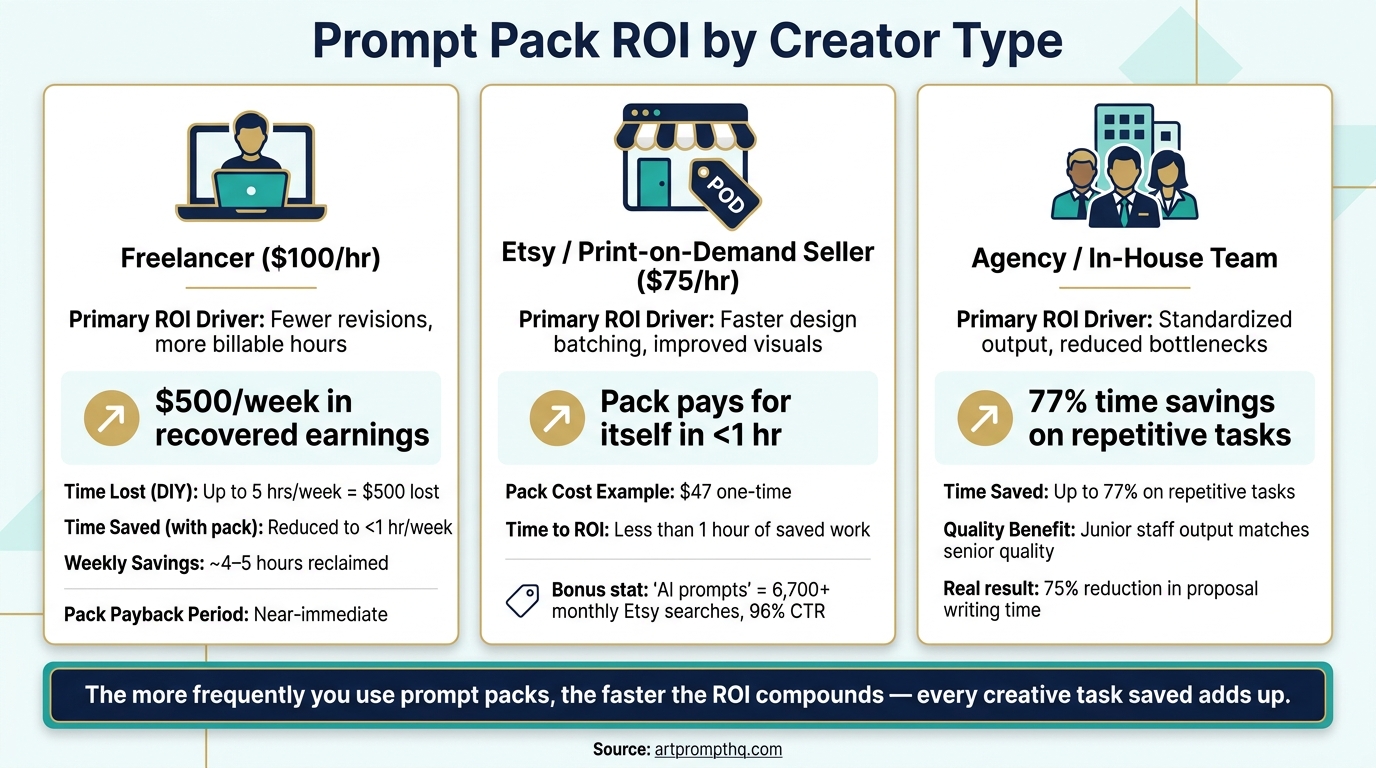
Prompt Pack ROI: DIY Prompting vs. Using Prompt Packs
Building on the earlier discussion of saving time and improving quality, let’s explore how prompt packs provide measurable ROI across different types of creators and businesses.
Freelancers and Solo Creators
For freelancers charging $100 per hour, creating prompts from scratch can be a hidden expense. Spending up to five hours a week on DIY prompting translates to $500 in lost billable time [2]. A well-organized prompt pack can cut this down to under an hour, reclaiming 4–5 hours weekly. The cost of the pack is often recouped almost immediately.
The benefits extend beyond time savings. With fewer rounds of revisions, projects wrap up faster, boosting your effective hourly rate for fixed-price work. As the team at Expert AI Prompts aptly states: "Every minute spent tweaking a generic prompt to sound less generic is a minute stolen from business development, strategic planning, or personal time." [2]
Etsy and Print-on-Demand Sellers
For Etsy and print-on-demand sellers, prompt packs simplify the creation of cohesive, high-quality designs. This helps maintain consistent branding and improves conversion rates [11]. Packs focused on specific aesthetics - like watercolor animal portraits or boho nursery art - allow sellers to create entire product lines efficiently, rather than piecing together one-off designs. Using a multi-category prompt pack can further accelerate this process by providing a vast library of pre-tested styles.
If a seller values their time at $75 per hour, a $47 prompt pack pays for itself in less than an hour of saved work [3]. On Etsy, the term "AI prompts" alone sees over 6,700 average monthly searches with a 96% click-through rate [11], making standout visuals a key driver of sales.
"Instead of spending 20 minutes crafting a prompt that produces mediocre output, you spend 2 minutes filling in variables and get an 80% finished result." - Rey Midas, Founder, Midas Tools [4]
Agencies and In-House Teams
Agencies managing multiple campaigns benefit from streamlined prompts that save time while raising the quality of their output. Prompt packs act as a shared creative framework, enabling junior staff to produce work that matches senior-level quality. This reduces bottlenecks and allows senior team members to focus on strategic tasks. Sarah L., Founder of Spark Creative, noted that her team reduced proposal writing time by 75% after adopting a specialized prompt toolkit, with junior writers delivering content on par with senior staff [12].
Automation and structured prompting can save up to 77% of the time spent on repetitive tasks [6]. For agencies juggling multiple client campaigns, this efficiency boost translates into higher profit margins or the ability to take on more projects without increasing staff.
| Business Type | Primary ROI Driver | Estimated Time Saved |
|---|---|---|
| Freelancer ($100/hr) | Fewer revisions, more billable hours | ~4–5 hrs/week [2] |
| Etsy/POD Seller ($75/hr) | Faster design batching, improved visuals | Pack ROI in < 1 hr [3] |
| Agency/In-House Team | Standardized output, reduced bottlenecks | Up to 77% on tasks [6] |
These examples show that, whether you’re a freelancer, an Etsy seller, or part of a larger team, structured prompt packs consistently save time and elevate creative output.
In essence, the ROI of a prompt pack grows with the frequency of repetitive creative tasks - the more you use it, the quicker the payoff.
How to Tell If a Prompt Pack Is Worth Buying
Before spending money on a prompt pack, it’s smart to evaluate its usefulness based on practical criteria.
Key Factors to Check Before You Buy
Start by confirming that the pack aligns with your specific needs. Whether your focus is e-commerce visuals, brand content, character design, or monetizing AI art, the pack should seamlessly integrate into your workflow.
Another crucial aspect is prompt depth. High-quality packs go beyond surface-level instructions. They include essential details like context variables, tone guidelines, output format specifications, and quality checks. Rey Midas, Founder of Midas Tools, emphasizes this point:
"A pack with 50 shallow prompts like 'write a blog post about [topic]' is worthless. You want prompts with context variables, output format instructions, tone constraints, and quality guardrails." [4]
Model compatibility and update policies are equally important. Packs that work with multiple models reduce the risk of being locked into a single platform. If a platform changes its pricing or removes features, a single-platform pack might become useless. Additionally, AI models evolve quickly - new versions like Midjourney v7, Sora 2, and Veo 3 often behave differently. Packs that are regularly updated to reflect these changes provide better long-term value. [1] [4]
These considerations help you identify packs that genuinely improve your productivity and creative output.
Red Flags That Signal a Low-ROI Pack
If a pack doesn’t meet the key criteria above, be cautious of the following warning signs.
The biggest red flag is a pack filled with generic one-liner prompts. For example, "create a logo for [brand]" offers no more value than typing directly into an AI tool. Such prompts won’t save you time or improve the quality of your work.
Platform lock-in is another issue to avoid. Subscription-based libraries bundled into software priced at $49/month can cost you $588 annually - and if you cancel, you lose access entirely. In contrast, a one-time purchase pack that you can save locally and use across models is often a more cost-effective option, especially for solo creators or small teams. [4]
Also, beware of packs that don’t provide example outputs. If the creator can’t show what the prompts actually produce, you have no way to judge their quality before buying.
| Red Flag | Why It Hurts ROI |
|---|---|
| One-liner prompts | Leads to more editing and lower-quality results [4] |
| Platform lock-in (subscription only) | Costs up to $588/year and access is lost if canceled [4] |
| No example outputs shown | Prevents you from verifying quality before purchase |
| Single-model compatibility | Becomes obsolete if the model updates or changes [4] |
| No update policy stated | Pack loses relevance as AI models evolve [1] |
By avoiding these pitfalls, you can protect both your workflow efficiency and your creative consistency.
Finally, consider the cost-per-prompt to gauge value. A $29 pack with 200+ well-designed prompts is a much better deal than a $5 pack offering just 10 generic lines. [4]
Where to Find High-ROI Prompt Packs on Art Prompt HQ
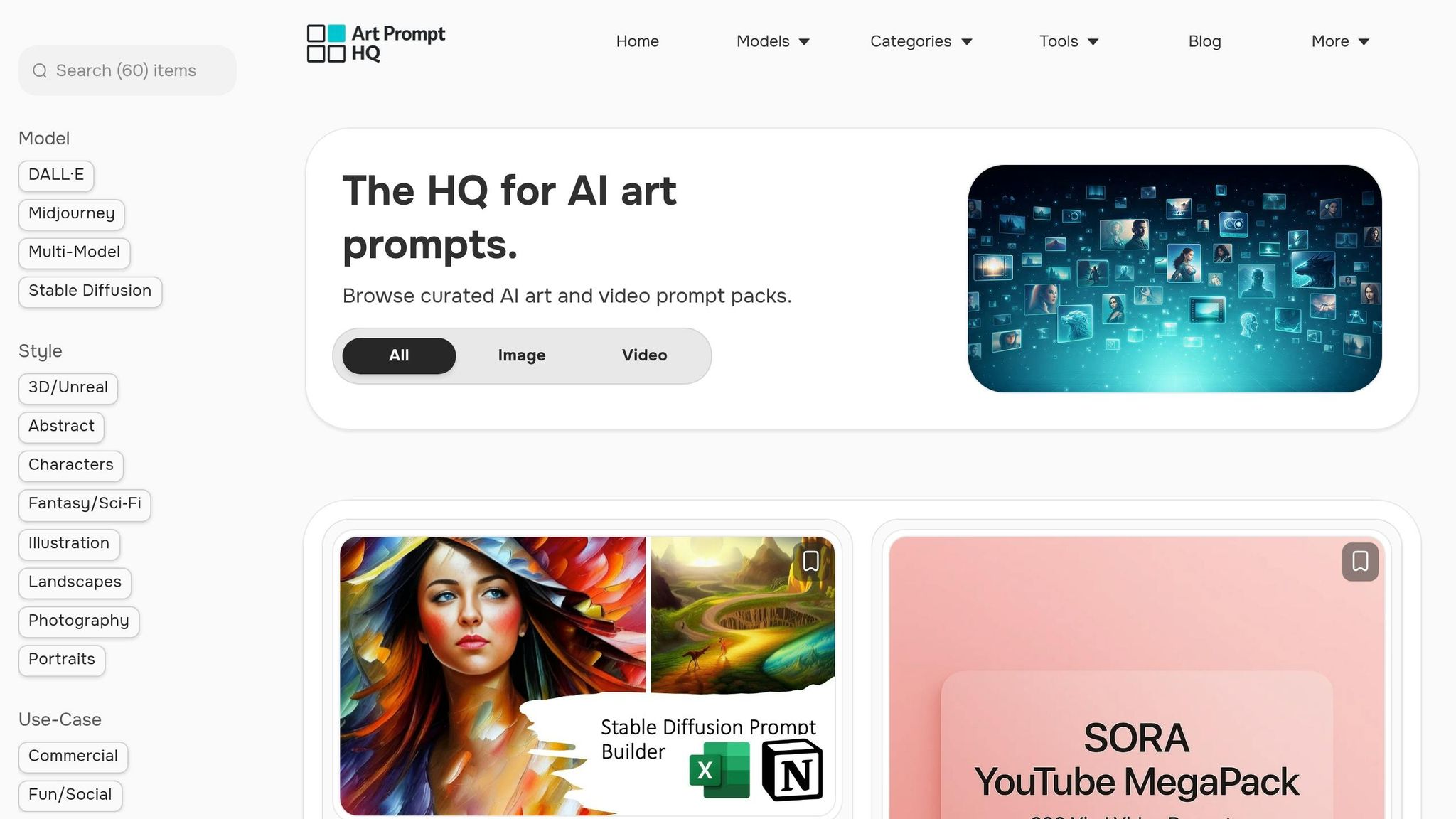
Art Prompt HQ focuses on one goal: helping creators skip trial-and-error and start with prompts that deliver results.
"Art Prompt HQ is your shortcut to professional AI art prompts - organized by model, style, and goal so you can skip trial‑and‑error and go straight to predictable, client‑ready results." [1]
Every pack is tagged by AI model (Midjourney, Stable Diffusion, DALL·E, Sora 2, Veo 3), visual style, and purpose. This tagging system ensures you don’t waste time scrolling through unrelated options. Instead, you can quickly filter for the prompts that align with your creative process. Here are some key categories tailored for different needs.
Prompt Packs for Commercial and E-Commerce Work
For creators focusing on marketing, product photography, or client deliverables, commercial and e-commerce packs are designed to deliver reliable, on-brand visuals. These packs include Master Systems, which are structured frameworks ideal for producing consistent outputs at scale. They’re especially useful for maintaining a unified visual identity across campaigns or product lines, making them a practical choice for anyone looking to maximize efficiency and ROI in their creative work.
Packs Built for Portfolio Work
If you’re aiming to enhance your professional image through AI art, the portfolio-ready packs go beyond just creating beautiful visuals. These packs act as learning tools, helping you understand how specific tokens influence lighting, composition, and mood. Featuring styles like Neo-Ghibli, Retro-Futurism, Cyberpunk, and Editorial Photography, they allow you to craft a cohesive and standout portfolio with a distinct visual identity.
AI Art Monetization Guides
Creating stunning visuals is only half the journey. The AI art monetization guide helps you turn your creations into income. Perfect for Etsy sellers, print-on-demand creators, and solopreneurs, this guide bridges the gap between producing impressive art and understanding how to market and sell it effectively.
Art Prompt HQ also offers free tools to enhance your workflow, such as the AI Art Style Finder, Midjourney Prompt Tool, and AI Image Prompt Refiner. These resources allow you to refine your ideas before diving into the curated AI prompt packs, all tailored to your specific model, style, and creative goals.
Conclusion: Making Prompt Packs Work for You
The idea behind the return on investment (ROI) of prompt packs is straightforward: a small, one-time purchase can save countless hours otherwise lost to trial-and-error. For example, if you value your time at $100 per hour, just one week of experimenting with prompts could cost you $500 in missed opportunities [2]. A well-chosen pack transforms that wasted time into productive time.
The benefits show up in three main ways: speed (you spend less time tweaking to get a usable result), quality (your initial outputs are closer to being client-ready), and consistency (your visuals stay on-brand across projects). These advantages build up over time, particularly for creators handling recurring tasks or campaigns.
Choosing the right prompt pack is essential to unlocking these benefits. Make sure it aligns with your AI model, your goals, and your workflow. Whether you're a freelancer looking to maximize billable hours or part of an agency aiming for consistent results, look for packs that go beyond surface-level aesthetics. Packs that include technical details - like model parameters and advanced tokens - can double as learning tools, helping you refine your own prompt-writing skills over time.
"Investing in proven systems isn't an expense; it is a strategic decision to buy back your freedom." - Expert AI Prompts [3]
FAQs
How do I calculate ROI for a prompt pack?
Calculating the ROI for a prompt pack is straightforward. Use the formula: ROI = (Net Benefits – Cost) / Cost × 100%. Start by identifying the benefits, such as time saved (e.g., hours saved × hourly rate), enhanced output quality, or quicker project completions. Subtract the pack's cost from these benefits, then divide the result by the cost.
For example, if a pack helps you save 10 hours a week and your hourly rate is $50, that’s $500 in weekly value. Comparing this to the pack’s cost gives you a clear picture of its worth.
Which AI model should my prompt pack support?
Choosing the right AI model for your prompt pack depends on your tools and creative goals. If you're aiming for detailed, stylized images, look for packs created for models such as Midjourney or Stable Diffusion. For video or text-to-video projects, explore packs designed for models like Sora or Veo. Using prompt packs tailored to your specific model not only improves the quality of your results but also saves time and minimizes guesswork.
What makes a prompt pack high-quality?
A well-crafted prompt pack is like a reliable blueprint for achieving polished, consistent results. These packs are designed to align with specific styles or objectives, offering structured prompts that manage key elements like style, lighting, composition, and mood. Tailored for the latest AI models, they come with straightforward documentation, making it easier to adjust and use prompts across various projects. This mix of dependability and straightforward guidance helps creators work more efficiently while producing professional-grade outputs.