If you're tired of wasting hours on trial-and-error with AI art tools like Midjourney, Stable Diffusion, or DALL·E, paid prompt libraries can save you time and frustration. These curated collections of tested prompts are designed to produce consistent, high-quality results, whether you're working on brand campaigns, client projects, or personal art.
This guide breaks down the types of paid prompt libraries available, how to evaluate them, and why they can make your workflow faster and more reliable. From single-tool packs (like a Midjourney prompts pack) to niche-specific collections, you'll learn how to choose the right library for your needs and get the most out of your AI art tools.
Types of Paid Prompt Libraries and Their Use Cases
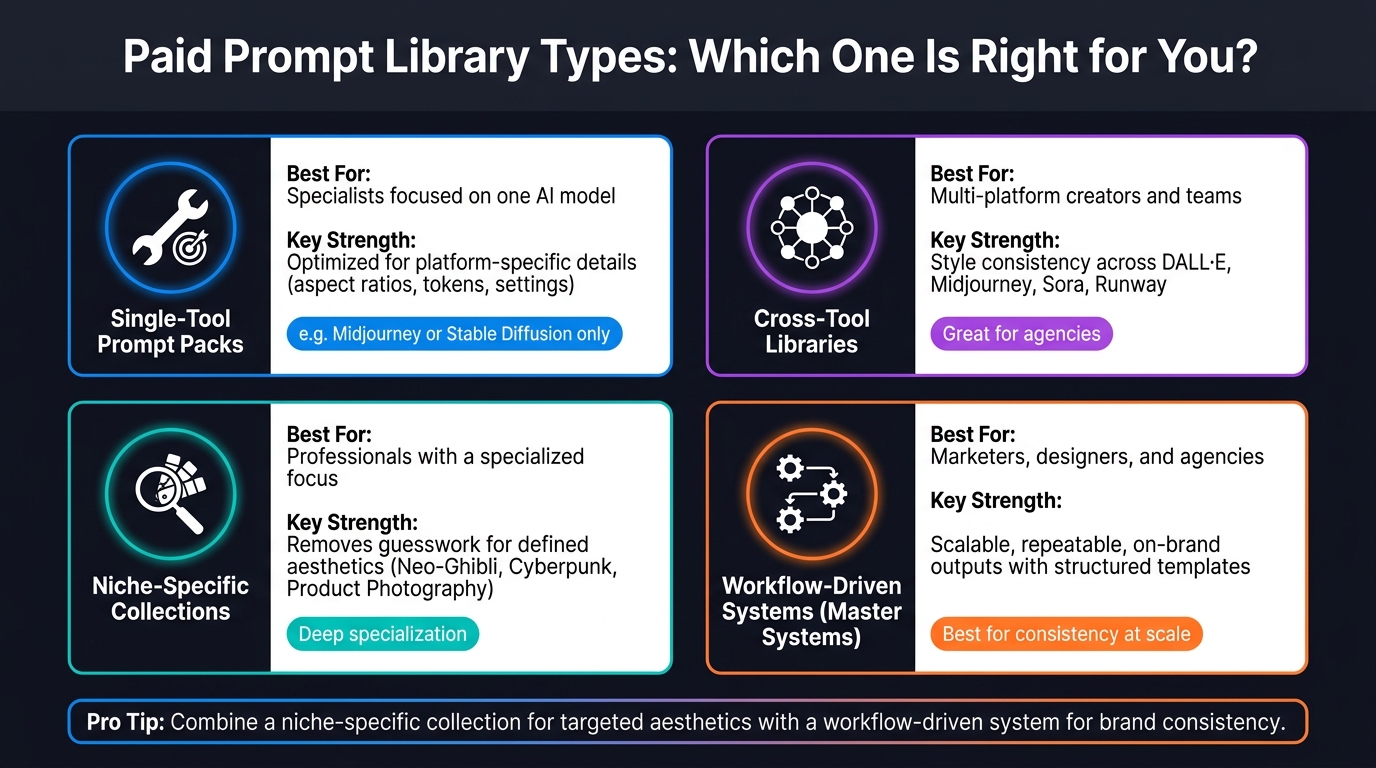
Paid Prompt Library Types: Which One Is Right for You?
Paid prompt libraries come in a variety of forms, each designed to address specific needs and challenges in AI art generation. Choosing the right type of library can make a big difference in how well it fits into your creative process. Below are the four primary categories, tailored to different workflows and goals.
Single-Tool Prompt Packs
These are designed exclusively for one AI model, such as Midjourney or Stable Diffusion. By focusing on a single platform, they delve into details like aspect ratios, stylization, quality settings, and how tokens behave. This makes them ideal for creators who work primarily with one model and want optimized results. However, they may not be as useful if you decide to switch to a different tool.
Cross-Tool Libraries
Cross-tool libraries are perfect for creators who use multiple platforms. For instance, a marketer might use DALL·E for product images, Midjourney for concept art, and Sora or Runway for video content. These libraries organize prompts by style or purpose rather than by platform, ensuring visual consistency across different tools. This approach works particularly well for teams or agencies where members use various tools but aim for a unified style.
Niche-Specific Collections
Focused on a single aesthetic or professional use case, niche-specific collections dive deep into specialized areas like product photography, fantasy and sci-fi art, or viral short-form videos. These packs take the guesswork out of achieving a specific look. As Art Prompt HQ explains, their purpose is to provide "blueprints for specific looks like Neo-Ghibli, Retro-Futurism, cyberpunk, and editorial photography - each pack is tested to produce a consistent visual style, not one-off lucky generations." [1] For creators with a clear focus, these collections often deliver more reliable and visually cohesive results than broader libraries.
While niche collections are excellent for achieving specific aesthetics, other systems prioritize workflow efficiency.
Workflow-Driven Prompt Systems
Sometimes called "Master Systems", these go beyond simple lists of prompts. They offer structured templates that help you produce repeatable, consistent results across various projects. Instead of just providing prompts to copy and paste, these systems explain how different elements - like tokens for lighting, mood, or subject changes - work together. This makes them a great choice for marketers, designers, and agencies that need dependable, on-brand visuals on a regular basis. Art Prompt HQ describes these systems as "ideal for marketers, designers, and creators who need repeatable, on-brand outputs." [1]
| Library Type | Best For | Key Strength |
|---|---|---|
| Single-Tool Pack | Specialists focused on one model | Optimized for specific platform details |
| Cross-Tool Library | Multi-platform creators and teams | Ensures style consistency across tools |
| Niche-Specific Collection | Professionals with a specialized focus | Removes guesswork for defined aesthetics |
| Workflow-Driven System | Marketers, designers, and agencies | Scalable, repeatable, on-brand results |
Many creators find success by combining these approaches. For instance, they might use a niche-specific collection to achieve a particular look while relying on a workflow-driven system to maintain consistency across broader projects.
sbb-itb-997826f
How to Evaluate Paid Prompt Libraries
Once you've identified a library type that matches your workflow, it's crucial to dive deeper into specific factors to ensure you're making a worthwhile investment. Four main aspects - documentation, licensing, updates, and visual proof - can help you gauge the quality and reliability of a prompt pack. These elements refine the selection process, ensuring you're equipped with tools that deliver consistent results.
Clarity and Documentation
A good prompt library does more than provide a list of phrases to copy and paste. It should explain why the prompts work. High-quality packs often include details about token effects, such as how they influence lighting, composition, and mood. They also provide variable templates (e.g., {{subject}} or [PRODUCT]) that allow you to customize prompts without starting from scratch. If a library only offers generic one-liners with no explanation, it might prioritize quantity over usability - an indicator to proceed with caution.
Licensing and Commercial Use Rights
Licensing is an essential consideration, particularly for freelancers and agencies. Confirm whether the library explicitly grants commercial use rights, as some restrict these to higher-tier plans. Also, check for rules on redistribution - many libraries forbid reselling or even internal sharing of prompts. Ensuring the license aligns with your intended use, whether for client projects, marketing campaigns, or product listings, is vital to avoid legal complications.
Updates and Support
AI models change frequently, and even well-designed prompts can become less effective after major updates. To stay ahead, look for libraries that display their last update date or version history. This transparency shows that the creators actively fine-tune their prompts as models evolve. Additionally, access to priority support can be a lifesaver, especially if you depend on these prompts for professional or client-facing work.
Visual Previews and Example Outputs
Before committing to a purchase, check if the library includes actual images generated from its prompts. Reliable packs offer clear examples, often accompanied by details like the model version, aspect ratio, and settings used. This proof helps you assess whether the outputs align with your creative goals. For niche libraries - such as those tailored for product photography - consistency across multiple examples is more telling than a single impressive result.
Here’s a quick summary of the key evaluation factors:
| Evaluation Factor | What to Check | Why It Matters |
|---|---|---|
| Documentation | Token breakdowns and variable templates | Lets you adapt prompts for your specific needs |
| Commercial Rights | Clear license terms for each tier | Ensures legal use for business and client work |
| Update Policy | Visible version history and update frequency | Keeps prompts effective as AI models evolve |
| Visual Proof | Generated examples with detailed settings | Verifies the pack delivers consistent, quality results |
Large Libraries vs. Focused Prompt Packs: How to Choose
What Large Libraries Do Well
Large libraries shine when you're stepping into unknown territory. For example, if you're experimenting with a new model like Midjourney v7, having access to thousands of prompts across various styles can help you quickly understand the model's capabilities. Some libraries boast over 3,400 curated prompts spanning multiple models [3]. This makes them a great resource for activities like moodboarding, pitching creative concepts to clients, or simply finding a starting point when you're uncertain about your direction.
However, there's a tradeoff: quality can vary. While some prompts may deliver excellent results, others might fall short, meaning you’ll spend additional time sorting through them instead of diving straight into your work.
Why Focused Packs Often Work Better
If you already have a clear vision - like achieving a professional product photography pack or a specific fantasy aesthetic - a focused pack can be your best ally. These packs are designed with a single purpose in mind, offering consistent, reliable results tailored for that specific use case. They’re also great learning tools. As Art Prompt HQ explains:
"packs double as teaching tools so you can see which tokens control style, lighting, composition, and mood." [2]
This makes them particularly valuable for professionals working on client projects or developing a cohesive visual brand, where trial-and-error workflows can quickly become expensive.
Mixing Both in One Workflow
Using both large libraries and focused packs in tandem can bring out the best of both worlds. Large libraries are excellent for the early stages of a project, allowing you to explore various styles and pitch ideas. Once you’ve settled on a direction, focused packs take over, ensuring consistent and efficient production.
Think of this as a layered approach: a subscription-style library keeps you updated with the latest models and styles, while a couple of targeted packs support the specific aesthetics you rely on regularly. This combination provides both creative flexibility and dependable results, eliminating the need to choose between exploration and precision. It’s a workflow that aligns perfectly with curated collections like those featured at Art Prompt HQ.
| Large Libraries | Focused Packs | |
|---|---|---|
| Best for | Exploration, moodboarding, model testing | Client work, brand assets, repeatable styles |
| Quality | Variable; requires filtering | High; tested for specific results |
| Learning curve | Longer; more options to sort through | Shorter; built for fast adoption |
| Ideal stage | Project start | Production phase |
In essence, large libraries help you find your creative direction, while focused packs ensure you execute it with precision.
How Art Prompt HQ Fits Into the Paid Prompt Ecosystem
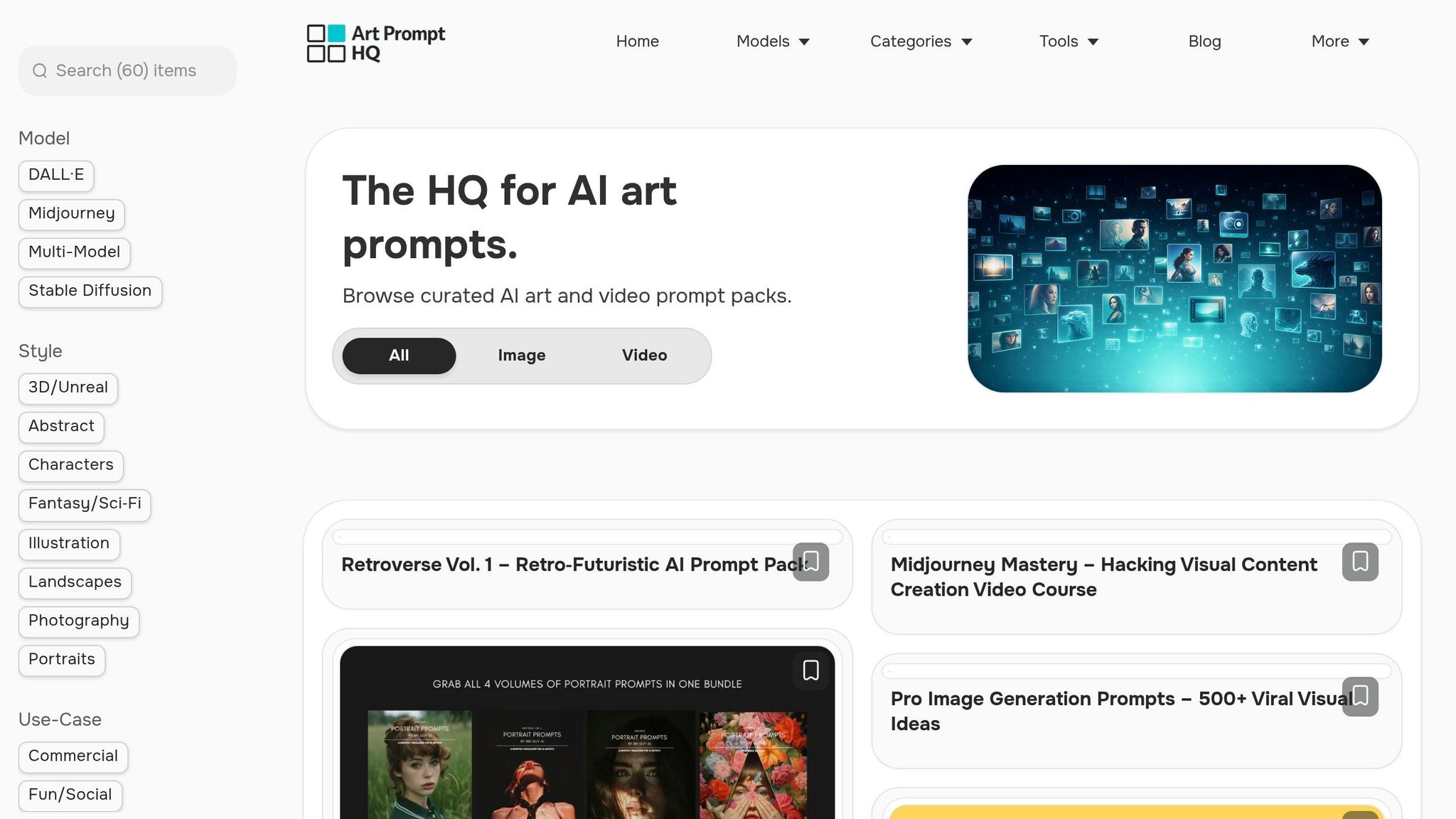
Curated Packs vs. Unstructured Libraries
Many raw prompt libraries provide long, unorganized lists, leaving users to sort through and test what might work. Art Prompt HQ approaches things differently by offering curated packs that are structured for consistency and tailored to specific models, styles, or objectives.
This distinction becomes clear when you open one of their packs. Instead of guessing which prompts might deliver the right results, you get a system designed for practical use:
"This isn't a toy gallery - it's a working toolkit for people who rely on AI visuals." [2]
Each curated pack serves as a blueprint, allowing you to swap subjects while maintaining essential elements like lighting, composition, and mood. These packs are categorized by model (Midjourney, Stable Diffusion, DALL·E, Sora 2, Veo 3), style (editorial photography, Neo-Ghibli, Retro-Futurism), and goal (Commercial, Viral Shorts, Portfolio, Learn Prompting). The focus on aligning with specific goals is a standout feature, helping users not just achieve a particular style but also meet business or creative objectives. This structure ensures that Art Prompt HQ packs are ready to integrate seamlessly into your workflow.
Using Art Prompt HQ to Build Your Prompt Stack
Art Prompt HQ goes beyond individual packs by helping you assemble a cohesive prompt stack that matches your project’s needs. When selecting a paid prompt library, it’s important to consider how its structure complements your existing workflow - and Art Prompt HQ is designed to support smooth transitions from brainstorming to production.
For commercial projects, the commercial AI art prompts category provides systems crafted for product photography and e-commerce visuals. If your work leans toward fantasy or sci-fi, the fantasy & sci-fi prompts category offers consistent styles that go beyond standalone prompts. For short-form video creators, the video prompts and viral shorts categories include packs tailored for tools like Sora and Veo. You can browse curated prompt packs across all these categories, while the learn AI art prompts section focuses on developing prompting as a skill rather than relying on shortcuts.
Additionally, Art Prompt HQ includes free tools like the AI Art Style Finder, Prompt Refiner, and Negative Prompt Generator to help fine-tune your prompts before using any credits.
"Whether you are producing daily social content, client campaigns, or a full AI art business, the directory and tools are organized by model, style, and intent so you can plug them directly into existing pipelines." [2]
Art Prompt HQ serves as the structured foundation of your prompt stack, offering a dependable source of organized prompt systems while still allowing room for exploration and creativity.
Final Checklist Before Buying a Paid Prompt Library
Pre-Purchase Checklist
Before committing to a purchase, make sure to check the following:
- Model compatibility: Ensure the library is designed for the specific model version you use, such as Midjourney v7, Flux 1.1 Pro, Stable Diffusion 3.5, Sora 2, or DALL·E. Prompts tailored to older versions might not work well with updated models, leading to inconsistent results.
- Visual proof: A reliable library should include real outputs generated by the prompts, not just polished marketing images. If actual examples are missing, it may be worth exploring other options.
- Human curation: Verify that the prompts have been tested and refined by real artists rather than being mass-produced through automation. Hand-crafted packs often deliver more dependable results.
- Licensing terms: Confirm that commercial rights are included, especially if you plan to use the outputs for client work or resale. Some libraries may require higher subscription tiers for commercial use.
- Update policy: Check whether the library has a clear schedule for updates. Without regular updates, prompts can become outdated as models evolve.
- Documentation quality: Look for packs that explain the mechanics behind their prompts, such as how specific tokens influence lighting, composition, or mood, rather than just providing plain text.
- Refund or trial option: Opt for libraries that offer a free tier, sample pack, or a money-back guarantee. This allows you to test the quality before committing to a full purchase.
Keeping Your Prompt Stack Current
Once you’ve chosen a library that meets your needs, it’s important to maintain and adapt your prompts as models continue to evolve.
Each time a major model update occurs - like an upgrade to Midjourney v7 or Flux 1.1 Pro - review your saved prompts and tips. Test them to see if they still produce consistent results. If they don’t, either revise them or remove them from your collection to avoid clutter and confusion.
For prompts that need minor tweaks, treat them as living documents. Platforms that allow version tracking can be immensely helpful. By keeping a record of changes, you can easily revert to earlier versions that worked well with specific model iterations. This is particularly useful for reproducing client projects or revisiting past successes. Art Prompt HQ’s structured packs are specifically designed to maintain this level of consistency while allowing for fine-tuning.
"Your style prompts are your intellectual property. Version every iteration and never lose the exact recipe that created a masterpiece." - Noir Prompt
Finally, don’t hesitate to experiment. Paid packs provide a strong foundation, but your personal variations will make your library truly your own. Swap out subjects, tweak parameters, and save these customized prompts within your stack. Over time, this personalized approach will enhance your workflow and ensure your library remains aligned with your unique style and needs. By integrating these habits, you’ll keep your prompt stack relevant and effective, no matter how tools and models evolve.
FAQs
Do paid prompt libraries actually improve results?
Paid prompt libraries can be a game-changer when used wisely. They provide carefully crafted and tested prompts that help deliver consistent, high-quality results while cutting down on the guesswork. Many of these libraries come with structured templates, style guides, and technical keywords, making them particularly valuable for professional projects or client work. By selecting libraries that align with specific objectives, users can streamline their workflow and produce dependable, polished AI-generated art with greater ease.
Which prompt library type fits my workflow best?
The best prompt library for you hinges on your specific needs and workflow. If you're looking for ready-to-use, organized packs designed for particular models like Midjourney or Stable Diffusion, curated collections can save you time and cut down on guesswork. On the other hand, if you need a flexible system to manage and refine prompts across various tools, a customizable prompt manager might be a better fit. Your choice should align with your goals and how prompts fit into your creative process.
What license terms should I check before buying?
Before buying a paid prompt library, take the time to review the license terms carefully. Look into your usage rights and any restrictions that may apply. Verify whether the prompts are cleared for commercial use and if redistribution is permitted. Doing this helps you stay within legal boundaries and prevents any complications in your projects.