Selling AI prompt packs on Instagram can be a repeatable way to earn income by addressing specific problems for niche audiences. This case study breaks down how a fictional creator, Maya, successfully sold AI image prompt packs tailored for Etsy sellers, leveraging Instagram's visual features and DM automation to drive sales. By focusing on clear product outcomes, consistent posting, and reducing friction in the buying process, Maya turned her Instagram presence into a reliable sales funnel. Here's how she did it and what you can apply to your own strategy. To build a foundation for your own products, consider using an AI prompting master system to ensure consistent quality.
The Creator, the Niche, and the Offer
Maya’s ability to align her offer with her audience’s specific challenges became the backbone of her Instagram strategy. This strategy relied on visual storytelling to convert followers into buyers. Let’s meet "Maya" - a fictional yet relatable creator used in this case study to demonstrate a practical method for selling prompt packs through Instagram. Although Maya wasn’t a professional AI artist, she understood the struggles of her audience: Etsy sellers who spent countless hours revising product listings, only to see little to no improvement in traffic.
Defining the Creator's Niche
Maya honed her focus using the Pain + Proof + Purchase test [8], ensuring that her niche’s frustrations were significant enough to justify a paid solution. Her pitch - "I help Etsy sellers write high-converting listings without facing a blank screen" - influenced every detail of her product line. Her main offer, a 50-prompt Etsy Listing Pack for Midjourney and ChatGPT, was priced at $27. This pack included prompts for product photography, SEO-friendly title frameworks, and ready-to-use description templates. To attract more buyers quickly, she later introduced a smaller $15 starter pack as a low-risk entry point.
This level of precision proved more effective than many creators anticipate. Statistics show that 60–70% of those listing prompts on marketplaces earn less than $50 per month [9], often because they rely on sheer volume rather than addressing specific needs. Maya, on the other hand, focused on relevance. Her prompts were tailored to solve a single, well-defined problem for a specific group of sellers. This clarity naturally directed her to a platform where her niche audience was already active.
Why the Creator Chose Instagram
With her niche and goals clearly outlined, Maya selected Instagram as her primary platform, knowing it was where her audience - Etsy shop owners - already spent their time. These sellers frequently posted product photos and behind-the-scenes updates, making Instagram an ideal space to connect. More importantly, the platform allowed her to demonstrate the effectiveness of her prompts. For example, a short Reel showing a weak listing title transformed into a polished, ChatGPT-generated version in under 60 seconds provided instant proof of her product’s value.
"Instagram is different. You already have an audience that trusts you... Converting that existing relationship into product sales requires far less effort than acquiring cold traffic." - Vytas, Founder, CreatorFlow [4]
Maya also took advantage of Instagram’s organic discovery features, such as Reels and searchable captions, to attract new buyers without spending on ads. Since her flagship product was priced at $27, keeping her acquisition costs as low as possible was crucial for profitability from the outset.
In the end, the most effective niche isn’t necessarily the one with the highest search volume - it’s the one where you deeply understand the buyer’s everyday frustrations.
sbb-itb-997826f
Turning Prompts into Clear, Sellable Packs
Maya took her niche strategy a step further by transforming her ideas into a product people would want to buy. She understood that simply compiling prompts wasn’t enough; the key lay in presenting them as a solution to a specific problem.
Building Outcome-Focused Prompt Packs
Maya’s breakthrough came when she shifted her focus from listing what her pack included to highlighting the results it could deliver. For example, instead of labeling her product as “50 Etsy prompts,” she created "Etsy Listing Pack: Product Photos, SEO Titles & Description Templates for Midjourney + ChatGPT." This approach clearly communicated the value to buyers - saving them time and reducing frustration. To enhance the appeal, she divided her pack into three parts: core prompts, a quick-start guide with step-by-step instructions, and a bonus swipe file featuring 10 real Etsy listing examples. This layered structure made her $27 pack stand out from generic collections of prompts [8].
Naming and Structuring Packs for Clarity
To refine her product names, Maya used a simple formula: "I help [who] get [result] without [pain]." For her main pack, this became: "I help Etsy sellers write polished, SEO-ready listings without staring at a blank screen." This clear statement unified her product name, descriptions, and marketing materials.
She also structured the prompts into four sections for ease of use:
- A Quick-Start set with 8 prompts for immediate results
- A Core Workflow set of 30 prompts covering the entire listing process
- An Advanced set of 8 prompts for niche or seasonal products
- A Tuning Tips guide to help users align outputs with their shop’s unique style
This thoughtful organization made it simple for buyers to dive in, reduced the need for customer support, and earned her glowing reviews [10].
Using Curated Directories to Add Credibility
Building trust is crucial, especially when selling to new Instagram followers. Maya boosted her pack's credibility by listing it on Art Prompt HQ, a directory known for showcasing vetted prompt packs. This reassured potential buyers, particularly those who had been disappointed by low-quality packs in the past. For business-focused packs like Maya’s, categories such as commercial AI art prompts connected her directly with buyers who had specific needs. By aligning clear packaging with directory listings, Maya created a seamless experience that built trust and made the sales process smoother.
Instagram Content That Actually Sells Prompt Packs
Maya had to quickly highlight the value of her prompt packs and tips to new Instagram users. To guide potential buyers from discovery to purchase, she focused on three content formats, each designed to play a specific role in the sales funnel.
Educational Posts and Use Case Carousels
Carousel posts became one of Maya's most effective tools for building trust. Each slide offered practical insights, such as a mini-tutorial, a sample prompt output, or a breakdown of how AI benefits Etsy sellers. This "share a bit, sell the rest" strategy helped position her as an expert rather than just someone pushing a product. By offering valuable snippets, she encouraged users to save her posts, creating pre-sold buyers who were already interested in her packs before visiting her storefront.
Before/After Visuals and Reels
Reels showcasing transformations proved to be her most engaging content. Maya would record herself entering a generic prompt into Midjourney for a lackluster result, followed by a specialized prompt that yielded a much more polished output. The side-by-side comparison made the improvement obvious and compelling.
The opening hook was critical for success. According to research from SuccessPixel (April 2026), Reels starting with specific, measurable outcomes - like "I made $1,100 in 11 days" - averaged 14,200 views, while vague hooks like "How to grow using AI" drew only 340 views[3]. Maya adopted this approach, with her top-performing Reel starting with, "This one prompt change saved my Etsy clients 4 hours a week", immediately highlighting the benefit.
"Showing beats telling every time. The prompt is the demo - and the product." - AI Profit Mode[7]
While these visual comparisons built trust, Maya also ensured that every post included a strong call to action to convert interest into sales.
Writing Calls to Action That Convert
Instead of relying on "link in bio" as her main call to action, Maya implemented a more direct approach. Research shows that asking users to leave the app to find a link can result in a 70% drop in potential buyers due to the extra steps involved[4]. Maya's solution? End every Reel and carousel with "Comment LINK and I'll send you the link." Using ManyChat automation, she ensured that each commenter received the checkout link in their DMs almost immediately.
This tactic delivered impressive results. In one case documented by SuccessPixel (April 2026), a single Reel using the "LINK" trigger reached 22,000 views, initiated 187 automated DM conversations, and drove 63 sales - a 34% conversion rate - all without manual follow-up[3]. Maya replicated this strategy, ensuring her posts combined simplicity, immediacy, and efficiency.
"Digital product buyers want instant access. When someone comments 'LINK' at 11pm, they want the checkout page now, not tomorrow morning." - Vytas, Founder of CreatorFlow[4]
The Sales Funnel: From Scroll to Purchase
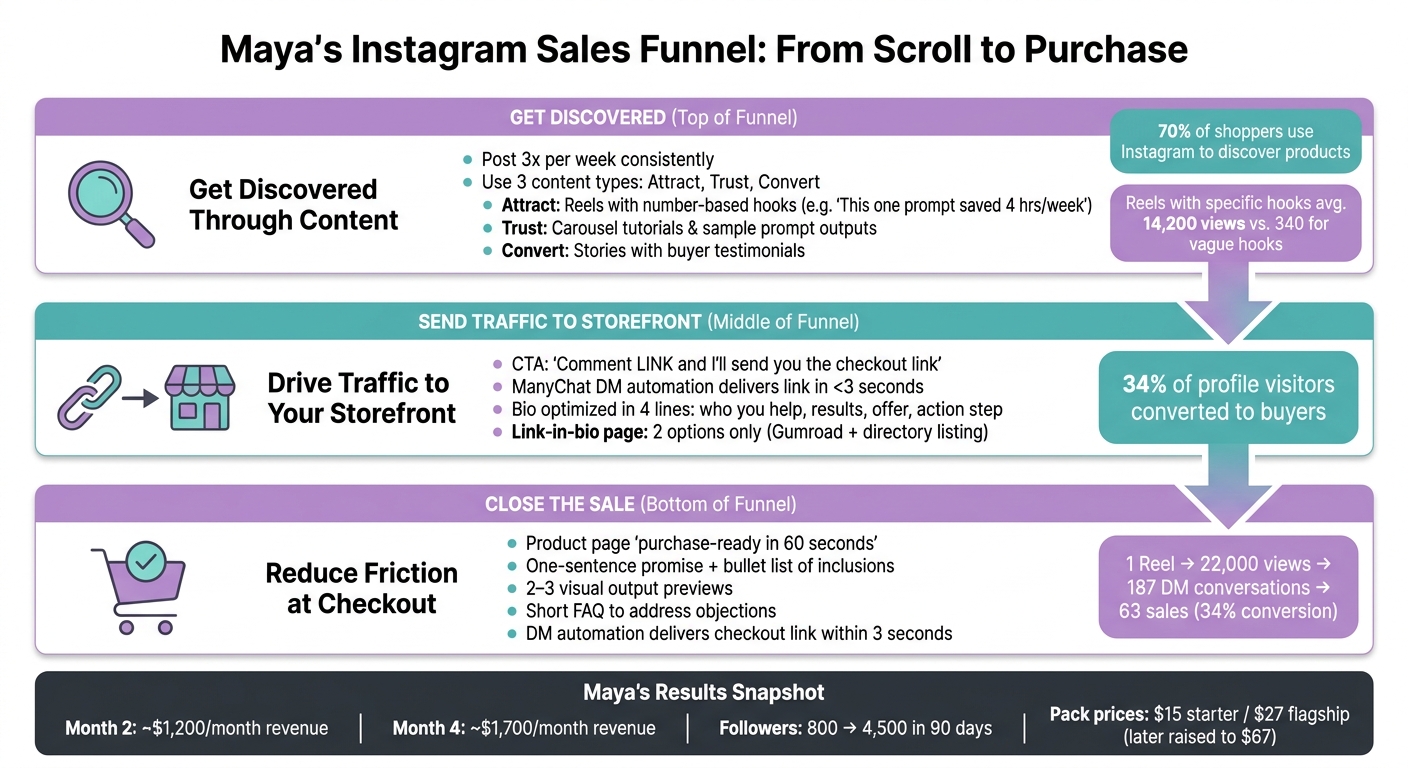
How to Sell AI Prompt Packs on Instagram: Maya's 3-Step Sales Funnel
Maya’s sales approach relied on a straightforward three-step process: get discovered, earn a click, and close the sale quickly. Each step was carefully planned to build on the one before it.
Getting Discovered Through Content
The first step in Maya’s funnel was creating content that made people stop scrolling. She alternated between three types of posts: Attract posts (like Reels with catchy, number-based hooks to grab attention), Trust posts (carousel tutorials and sample outputs to establish credibility), and Conversion posts (Stories showcasing buyer testimonials and product screenshots). A 2026 study by Success Pixel, which analyzed 59 Instagram creators, found that this content strategy helped one creator grow from 340 to 11,400 followers in just 60 days, generating $6,200 in sales [3]. Maya followed a similar plan, posting three times a week consistently rather than posting in short bursts and then going silent.
"The algorithm rewards routine. Creators who posted 3x per week consistently outperformed creators who posted 10x in week one then disappeared." - Success Pixel [3]
With 70% of shoppers using Instagram to discover products [4], Maya’s goal at this stage was straightforward: show up regularly and make her prompt packs’ value clear within seconds. This steady presence encouraged viewers to visit her storefront.
Sending Traffic to the Storefront
Once Maya had built visibility, her next step was guiding people to her storefront. She made this process as simple as possible, using a "Comment LINK" call-to-action (CTA) to send checkout links instantly through DM automation. Her Instagram bio also worked hard to convert visitors. In just four lines, it explained who she helps, the results she delivers, her offer, and an action step. This setup converted 34% of profile visitors into buyers [3].
Her link-in-bio page was equally streamlined. It included just two options: a primary link to her Gumroad storefront and a secondary link to her listings on Art Prompt HQ for those who preferred browsing a curated directory. By keeping the menu short and focused, she avoided overwhelming visitors with too many choices.
Reducing Friction at Checkout
With potential buyers arriving at her storefront, Maya focused on making the checkout process as smooth as possible. Her product pages were designed to be "purchase-ready in 60 seconds" [6]. Each page featured a one-sentence promise, a short bullet list of what the pack included, two or three visual previews of outputs, and a brief FAQ addressing common concerns. There was no lengthy text or unanswered questions to slow buyers down.
DM automation tools like ManyChat handled the final step, delivering checkout links within three seconds of a comment [4]. This instant response was critical - buyers commenting late at night were ready to buy immediately, not the next day. Paired with a clean and concise product page, this process kept the journey from discovery to purchase as quick and easy as possible.
"Digital products are underpriced almost universally. The mental anchor is 'it's just a file' but the buyer's real anchor is the hours it saves them. Price against the outcome, not the artifact." - Ayush Agarwal, Co-founder & CPTO, Dodo Payments [5]
For Maya’s funnel to work, every step had to be seamless. A weak discovery strategy, a cluttered bio, or a slow checkout process could derail the entire system at any point.
Results, Lessons, and Mistakes to Avoid
Example Numbers and Timeframes
Maya's journey brought in measurable, steady results. By her second month, she was earning roughly $1,200 from her two main packs, priced at $29 and $47. By month four, her income had climbed to about $1,700 per month, placing her in the $500–$2,000/month range that creators with 500+ engaged followers often achieve when combining digital products with DM automation [4]. These numbers reflect one case study and are not a guarantee of earnings.
Her follower count increased from about 800 to 4,500 within her first 90 days of consistent posting. While this growth was slower compared to some standout examples, like the creator in the Success Pixel study who jumped from 340 to 11,400 followers in just 60 days [3], Maya maintained a strong conversion rate. Her focus on AI art tailored for Etsy sellers, rather than a broader creative audience, kept her engagement high. These results provide a benchmark for understanding how specific strategies can deliver tangible outcomes.
Her timeline offers a realistic progression: Month 1 was focused on building and testing. By Month 2, she began seeing her first sales and validation. Month 3 brought compounding results as older Reels continued attracting new viewers. By Month 4, she felt confident enough to raise the price of her flagship pack from $47 to $67.
What Worked and Why
As discussed earlier, specific product naming and a consistent posting schedule were critical to Maya's success. The standout factor was her focus on product clarity. Instead of naming her packs generically, like "AI Art Prompts", she highlighted the exact outcomes buyers could expect. This approach shifted her from competing solely on price to emphasizing the value her products delivered.
Consistency in posting was just as important as content quality. By sharing three posts per week, she stayed visible in the algorithm and gave her audience a reason to keep engaging. Her "Attract, Trust, Convert" content strategy wasn’t just about promotion - it was an authentic way to teach and build credibility, making her sales feel natural rather than forced.
"The creators who hit $1,000 fastest did the opposite [of overthinking]. They validated first, built second, sold third." - Success Pixel [3]
DM automation also played a key role by instantly sending checkout links, preventing late-night drop-offs. However, Maya’s journey wasn’t without its challenges, and her early missteps offered some valuable lessons.
Mistakes That Cost Time and Sales
Maya encountered three major setbacks in her first month that slowed her progress.
Her initial pack, titled "AI Prompt Collection Vol. 1", failed to resonate because it didn’t communicate the benefit to buyers. Sales only picked up after she rebranded it with a name that clearly highlighted the outcome. As Aniket Chhetri, Founder of Grow With AI, explained: "Prompts don't sell. Outcomes do." [1] Along with a revamped product description, this change led to a noticeable boost in weekly sales.
She also struggled with over-committing to daily posts for three weeks, which led to burnout and a ten-day posting gap. This break hurt her reach and taught her that sustainable posting schedules outperform short bursts of activity. Posting three times a week proved to be both manageable and effective.
Another early mistake was relying on a "link in bio" for six weeks before switching to DM automation. As explained in the funnel section, reducing friction in the checkout process is crucial. Switching to a keyword-triggered system significantly reduced drop-offs between interest and purchase, showing how small adjustments can make a big difference in sales.
Ultimately, the difference between a slow start and a profitable month often comes down to three key factors: a product name that emphasizes outcomes, a consistent and manageable posting schedule, and a friction-free checkout process. These elements, when combined, create a foundation for steady growth and reliable results.
How Art Prompt HQ Fits into a Prompt Pack Business
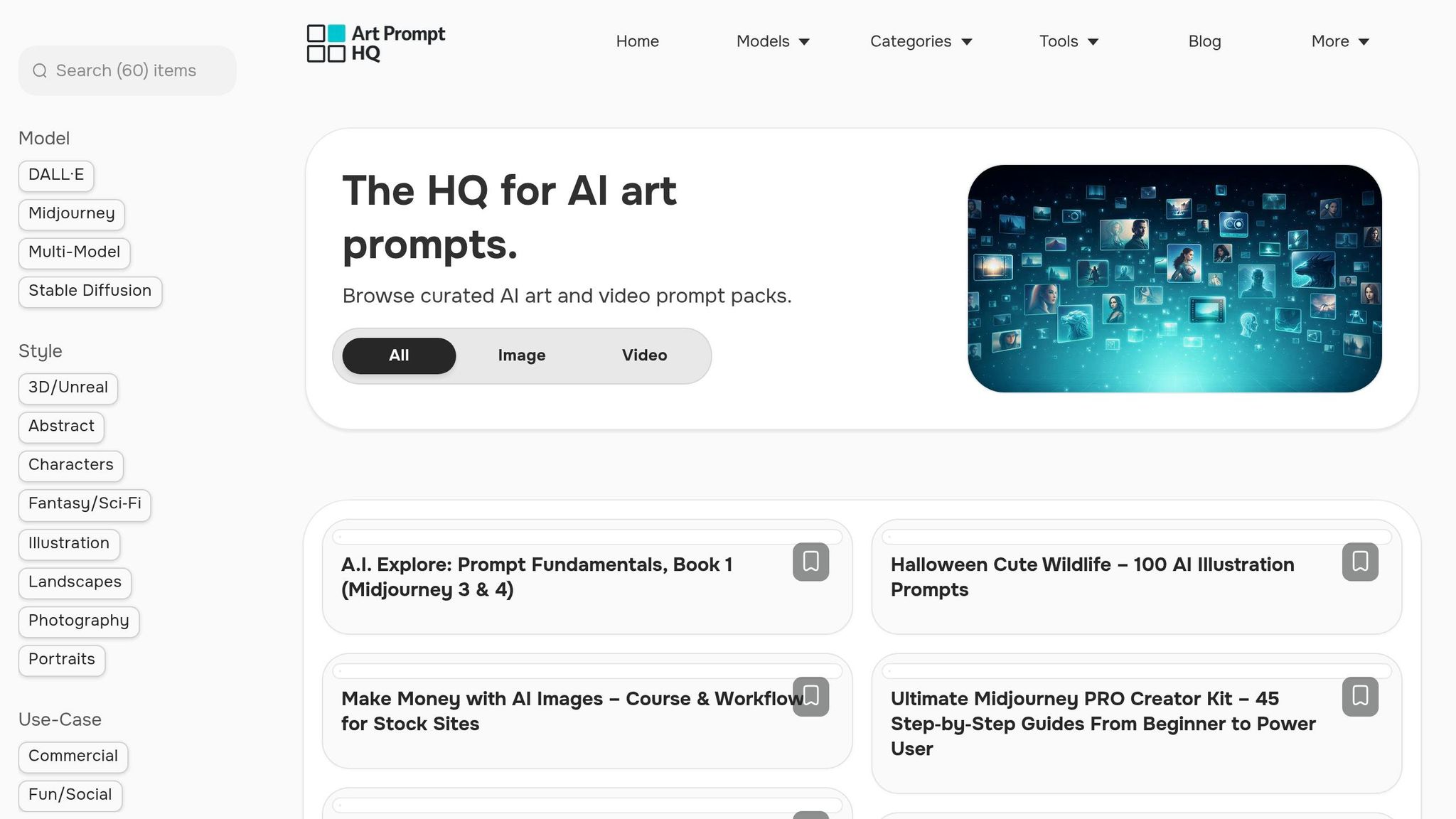
After fine-tuning her Instagram sales funnel, Maya decided to broaden her approach by targeting high-intent buyers through an external directory. While her Instagram strategy generated engagement, the platform's users often scroll aimlessly rather than make purchases. That’s where a curated directory like Art Prompt HQ complements her efforts, bridging the gap between interest and action.
Getting Found Through a Curated Directory
When someone searches for "AI prompt pack for Etsy sellers", they’re already in a buying mindset. An optimized listing on a curated directory captures this intent far more effectively than Instagram posts. Directories come with built-in discovery, ensuring your packs are visible to people actively searching for specific solutions rather than passively browsing [7]. This setup allows creators to focus on their products without needing additional marketing efforts.
For Maya, whose Etsy-focused packs cater to a clear commercial niche, being listed under commercial AI art prompts places her offerings directly in front of buyers seeking outcome-driven solutions.
"A product may need ten rounds of improvement: better title, better thumbnail, better first paragraph... Treat each product as an asset that can mature." - Sense Central [8]
This principle applies to directory listings as well. Crafting a title that matches what buyers are searching for - such as "Midjourney Prompts for Etsy Product Mockups" - can consistently attract warm leads without requiring constant updates or new content.
Building a Stronger Monetization Plan
Instagram fosters relationships, while a directory listing captures buyer intent, covering both the discovery and decision-making stages. By using Art Prompt HQ as a discovery tool, you can drive traffic to your main storefront, where higher-value bundles and upsells await [2].
For creators aiming to grow beyond a single pack or bundle and build a sustainable income, the AI art monetization guide on Art Prompt HQ provides strategies for pricing tiers, product sequencing, and structuring offers for long-term revenue. Combining these channels creates a solid foundation for scaling your monetization efforts effectively.
Conclusion and Next Steps
Key Takeaways from This Case Study
Maya's success stemmed from honing in on a specific niche, using outcome-focused prompts, and maintaining steady engagement on Instagram. Data from similar creators supports this approach. A 90-day analysis of 59 Instagram creators in 2026 revealed that 14 of them earned over $1,000 within their first 30 days by developing niche-tailored products and alternating between "Attract", "Trust", and "Conversion" content types [3]. One standout creator in the study gained 11,060 followers in just 60 days and made $6,200 in template sales - not by increasing their posting frequency but by focusing on strategic, thoughtful content [3].
The lesson here is clear: specificity drives sales. A targeted pack like "Midjourney Prompts for Etsy Product Mockups" will outperform a generic "AI art prompts" bundle because it directly addresses a buyer's specific needs. Use these insights to refine your own approach, and check out the resources below to take your strategy further.
Explore Art Prompt HQ for More Resources
Enhance your Instagram sales strategy with curated tools that guide potential buyers from initial discovery to final purchase. Whether you're just beginning or fine-tuning your process, Art Prompt HQ offers a wealth of resources to help. For creators targeting commercial buyers, the commercial AI art prompts section demonstrates how to position products with clear, outcome-driven messaging.
Dive deeper with the AI art monetization guide, which provides insights into pricing strategies, product sequencing, and building sustainable income. Plus, the directory allows you to list your prompt packs and connect with buyers actively looking for what you offer.
FAQs
How do I pick a niche that will pay for prompt packs?
When selecting a niche, concentrate on specific professionals who can genuinely benefit from your prompts to either save time or boost their income. Steer clear of overly broad or crowded topics like general productivity. Instead, focus on areas such as:
- Roles: Think about real estate agents, Shopify store owners, or freelance designers who need tailored solutions.
- Tasks: Address practical needs like crafting descriptions, writing outreach emails, or creating proposals.
- Budget: Aim for freelancers or business owners who recognize the value of investing in tools that enhance their workflow.
To ensure your niche has demand, dive into forums or marketplaces and see what people are actively searching for or discussing.
What should a prompt pack include besides prompts?
To get the most out of a prompt pack, it should go beyond simply providing a list of prompts. A well-rounded pack might include a quick-start guide to help users achieve results quickly, detailed explanations of each prompt’s purpose and how to use them, and example outputs to illustrate potential results. Incorporating workflow automation steps can further streamline the creative process.
Additional supporting materials, like checklists, templates, or presets, can enhance usability. Maintaining consistent formatting throughout the pack, adding version notes, and including a license document can also contribute to clarity and professionalism, boosting confidence for anyone purchasing or using the pack.
How do I set up DM automation to send links fast?
To streamline the process of sharing links through DMs, you can rely on third-party tools designed to work with Instagram. These tools are programmed to watch for specific keywords in comments, such as "LINK", and instantly send your store or checkout URL to the commenter’s DMs. This method eliminates the need for "link in bio" instructions, operates around the clock, and saves valuable time. Setting it up is straightforward and usually takes about 20 minutes.